
AI automation for service businesses in Sydney is becoming useful because it fixes the admin and follow-up gaps owners deal with every week.
The calls come in during a job, so they go to voicemail. The website form lands in an inbox that gets checked at 8pm. The quote goes out and then no one chases it. A warm enquiry from three weeks ago sits cold because nobody remembered to call back.
None of that is a marketing problem. It is an operations problem. And it is exactly the kind of problem AI automation is good at solving.
This guide explains what AI automation actually is for a service business, where it helps, what to automate first, what it costs, and how to avoid wasting money on gimmicks.
01
What Is AI Automation for Service Businesses?
AI automation for service businesses means using AI plus workflow tools to handle repeatable tasks like enquiry replies, call summaries, lead routing, quote follow-up, appointment reminders, review requests and customer updates. The goal is not to replace staff. The goal is faster, more consistent operations.
It helps to separate two things that often get lumped together.
An AI tool is something you open and use, like a chatbot you type into or a writing assistant. It waits for you.
AI automation is the opposite. It runs in the background, triggered by an event, and it does the next step without you remembering to. A form gets submitted, so a reply goes out. A call gets missed, so a text lands. A job gets marked complete, so a review request sends two days later.
Here are the kinds of workflows we mean in plain terms:
- A website form enquiry triggers an instant SMS and email follow-up.
- A missed call triggers an automatic text back to the caller.
- A quote sent triggers a follow-up sequence over the next week.
- A completed job triggers a review request.
- An inbox message gets logged to the CRM as a task with the right details attached.
Notice that none of these are exciting. They are boring, repeatable steps that happen dozens of times a week and get dropped when the team is busy. That is the point. Boring and repeatable is where automation pays.
02
Why Should Sydney Service Businesses Care About AI Automation Now?
AI adoption in Australia is accelerating, but many small businesses are still early. The Australian Bureau of Statistics reported in June 2026 that around 12% of Australian businesses used AI in the workplace in 2024–25, with small and micro business uptake around 11%.
That gap is the opportunity. Big businesses are moving fast. The ABS found 35% of large businesses reported using AI, up from 9% in 2021–22, and 22% of medium-sized businesses had adopted AI, compared with 3% previously. Small and micro operators are still sitting at around 11%, and even innovation-active small businesses only reached 19% adoption.
So if you run a service business in Sydney and you get one solid automation working this quarter, you are ahead of most of your local competitors, not behind them.
You do not need to overhaul the whole business to benefit. Service business workflows are highly repeatable. The same enquiry-to-quote-to-booking path runs every week. When a process repeats, it is easy to automate, and the savings compound every time it fires.
The ABS also found that 46% of Australian businesses reported finding ways to make savings and efficiencies through innovation and new technologies, including AI. That is the honest framing for this. It is not transformation. It is savings and efficiency on the boring parts, so the owner and team get their time back for the work only they can do.
Source: Australian Bureau of Statistics, Business Characteristics Survey 2024–25, released 25 June 2026. The survey covered nearly 7,000 Australian businesses.
03
What Tasks Should a Service Business Automate First?
The best first AI automation is usually the task that leaks revenue or owner time every single week. For most service businesses that means missed-call response, enquiry follow-up, quote follow-up, appointment reminders, review requests or a simple admin handoff.
Do not start with the thing that looks most impressive in a demo. Start with the thing that is costing you money quietly. Here is a rough priority order that works for most quote-based and appointment-based businesses:
- Missed calls and instant text-back
- Website form enquiry follow-up
- Quote follow-up
- Booking confirmations and reminders
- Review requests
- Lead qualification
- CRM updates and job notes
- Reactivation of old enquiries
To choose between them, weigh two things: how much revenue or time the task is leaking, and how hard it is to automate. That gives you a simple matrix.
Missed-call text-back, form follow-up, quote follow-up, reminders
Lead qualification and reactivation campaigns
Review requests and simple CRM logging
Complex, judgement-heavy tasks that need a human anyway
The top-left box is where you begin. High leakage, easy to build. That is a missed-call text-back or an instant enquiry reply, not a full AI receptionist that reinvents how you answer the phone.
You can self-assess with this checklist. For each item, ask: “Does this happen reliably every time, or does it depend on someone remembering?”
- Missed calls: does every missed call get a callback or text within minutes?
- Enquiry forms: does every form get a reply within the hour?
- Follow-up: does every unconverted enquiry get chased more than once?
- Quoting: does every quote get a follow-up if the client goes quiet?
- Reminders: does every booking get a confirmation and a reminder?
- Reviews: does every finished job get a review request?
- Reporting: do you know your response time and your enquiry-to-booking rate?
Any “no” is a candidate. The one that costs the most is your first automation.
04
How Can AI Automation Help Turn Enquiries Into Booked Jobs?
AI automation improves bookings by reducing response delays and making follow-up consistent. When a lead submits a form, calls after hours or asks for a quote, the system can respond, qualify, remind and route the enquiry without waiting for the owner to manually remember.
This is where a lot of Sydney service businesses get the diagnosis wrong. When bookings are soft, the instinct is to buy more leads. More ads, more traffic, more enquiries.
But from what we see at Good Problems, leads are often not the problem. The leak is between the enquiry and the booked job. Enquiries come in and then go slow, get a late reply or never get a second touch. Pouring more leads into a leaky process just wastes more leads.
A simple example: a quote-based business might get 30 enquiries in a month, reply quickly to 18, quote 12 and follow up with only 4. The automation opportunity is not more traffic. It is making sure every enquiry gets a fast first response and every quote gets chased.
- Speed to lead. The first business to respond usually wins the job. An instant automated reply buys you the conversation while the enquiry is still hot.
- Multi-touch follow-up. A short sequence over a few days catches the people who were busy the first time.
- After-hours cover. Enquiries that land at 9pm or on a Sunday get an immediate response instead of sitting until Monday.
- No-show reduction. Confirmations and reminders keep booked jobs on the calendar.
- Qualification before booking. A few smart questions up front mean you spend time on the jobs worth booking.
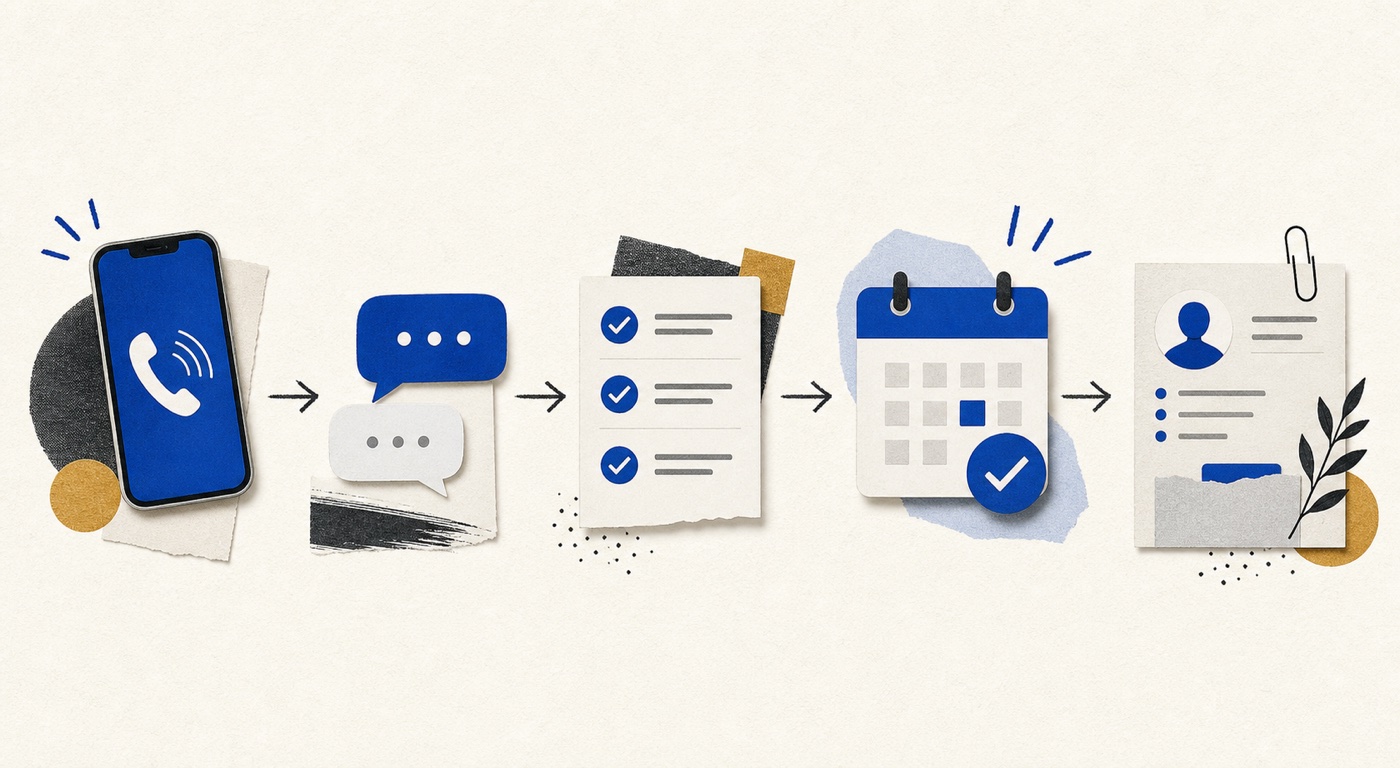
Here is what a single enquiry looks like running through an automated lead-to-booking flow:
- A prospect submits the website form.
- An instant SMS confirms you got the enquiry and sets expectations.
- The AI asks two to four qualifying questions to understand the job.
- A hot lead gets a booking link, or a live alert goes to the team.
- An enquiry that does not book gets a follow-up sequence over the next several days.
- The CRM records the source, the need, the urgency and the next action.
No step in that flow depends on someone remembering. That is the whole value. Consistency is what turns interest into booked jobs, and consistency is exactly what a busy team cannot guarantee by hand.
05
AI Receptionist, Chatbot or Workflow Automation: What Is the Difference?
An AI receptionist handles calls and conversations. A chatbot handles website or message-based questions. Workflow automation connects your tools behind the scenes. Most service businesses need workflow automation first, then conversational AI once the core follow-up process is clear.
These get mixed up constantly, and the mix-up leads to buying the wrong thing first. Here is the plain version:
- AI receptionist: answers the phone, routes calls, captures appointment details and handles after-hours or overflow.
- Chatbot: answers website questions, qualifies visitors and hands off to a booking.
- Workflow automation: updates the CRM, sends SMS and email sequences, chases quotes, logs job notes and moves information between tools.
| Tool | Best for | Risk | Best first use |
|---|---|---|---|
| AI receptionist | Missed calls and after-hours | Bad scripts frustrate callers | Capture and route enquiries |
| Chatbot | Website questions | Can feel gimmicky | Qualify and book |
| Workflow automation | Follow-up and admin | Needs a clean process | Lead-to-booking system |
The common mistake is installing a conversational bot before the underlying process is clear. If your offer, your qualifying questions and your follow-up steps are not defined, a bot just automates confusion. It answers callers with a script no one thought through and books the wrong jobs faster.
Get the workflow right first. Define what a good enquiry looks like, what questions matter and what happens after. Once that is solid, layering a receptionist or chatbot on top is straightforward, because the bot is just a new front door into a process that already works.
06
What Does AI Automation Cost for a Sydney Service Business?
AI automation cost depends on complexity. A simple missed-call or enquiry follow-up workflow can be relatively lean, while a full system with a CRM, an AI receptionist, quoting, reporting and multi-channel follow-up costs more because it touches more parts of the business.
Anyone quoting you a flat price before understanding your process is guessing. The cost is driven by scope, and scope depends on things like:
- How many workflows you are automating
- Which tools and platforms are involved
- How complex your CRM or pipeline is
- Your phone, SMS and email volume
- How much custom AI logic or prompting is needed
- How many integrations have to talk to each other
- Whether you need reporting and dashboards
There are also two separate costs to keep in mind: the setup to build it, and the ongoing management to keep it running and improving. A cheap build that no one maintains tends to quietly break.
Starter
Fix one leakage point, such as missed-call text-back or instant enquiry follow-up.
Growth
Lead capture, follow-up and booking working together as one flow.
Operator
A full enquiry-to-booking system with qualification, reminders, reactivation and reporting.
Most businesses should start at Starter, prove it works, then expand.
If you want pricing, start with an automation map. Find where the business is actually leaking time or bookings before anyone talks numbers.
07
What Are the Risks of AI Automation?
The main risks are not the AI itself. The real risks are automating a broken process, using vague prompts, mishandling customer data, sending robotic messages or adding tools the team will not use.
Automation is a multiplier. Point it at a good process and it multiplies the good. Point it at a bad one and it multiplies the bad, faster and at scale. So the risks worth naming are:
- Automating a broken process. If your follow-up is confused by hand, automating it just sends confused messages to more people.
- Hallucinations in customer-facing replies. An AI that makes up an answer to a customer erodes trust quickly. Customer-facing responses need guardrails.
- Data and privacy handling. Customer details need to be stored and moved responsibly. This is not optional.
- Tool sprawl. Ten disconnected tools is not a system. It is a new mess.
- No team buy-in. If the team does not trust or use the automation, it dies.
- Over-automating too early. Automating before your offer and process are clear locks in the wrong thing.
The way Good Problems builds around these risks is simple:
- Keep humans in the loop for high-value or unusual decisions.
- Start with narrow, well-defined workflows.
- Log everything so you can see what the system did.
- Write messages in plain language that sound like your business.
- Test with real scenarios before anything goes live.
AI does not fix a bad offer, bad service or a bad sales process. It makes an already-decent process faster and more reliable. Be honest with yourself about which one you have before you automate it.
08
How Should a Service Business Start With AI Automation?
Start by mapping the customer journey from first enquiry to booked job. Then find the biggest leakage point, build one automation around it, test it for two weeks and only expand once that workflow is reliable.
The mistake is trying to automate everything at once. The better path is narrow and proven:
- List every enquiry source: calls, forms, referrals, ads, socials and walk-ins.
- Identify where leads are missed or delayed today.
- Choose one workflow to automate: the highest-leakage one.
- Write the human version first. What would a great person do at each step?
- Build the automation to match that.
- Test it with real scenarios before switching it on fully.
- Measure response time, bookings, show-up rate and admin time saved.
- Expand to the next workflow once the first is reliable.
Step four is the one people skip. If you cannot describe what a great human would do at each step, the automation has nothing to copy. Write it out first, then build.
Good Problems can map this journey with you and build the first automation, so you are fixing a real leak instead of buying a tool and hoping.
Your practical first move
Book an AI Automation Audit
Want to know what your service business should automate first? Good Problems can map your enquiry-to-booking process and show where AI automation can save time or recover missed jobs.
We do not sell abstract AI. We build practical automation systems tied to booked jobs, faster follow-up, admin time saved and the revenue that is currently leaking between enquiry and booking.
Book an AI Automation Audit ↗Prefer to start smaller? Ask us for a simple automation map for your Sydney service business, and we will show you the two or three workflows worth fixing first.
09
Frequently Asked Questions
Is AI automation worth it for a small service business?
Yes, if it targets a real operational leak. AI automation is worth it when it saves owner time, improves response speed, follows up with enquiries or helps book more jobs. It is not worth it when it is installed as a novelty without a clear workflow behind it.
What is the best first AI automation for a service business?
Usually missed-call response, enquiry follow-up, quote follow-up or appointment reminders. These workflows are repetitive, measurable and close to revenue. They make better first projects than broad chatbots or complex internal AI tools.
Can AI replace admin staff?
Usually no. For most service businesses, AI should support admin staff by handling repetitive tasks, summaries, reminders and follow-up drafts. Human judgement should stay involved for unusual customers, complaints, pricing decisions and high-value jobs.
Do Sydney service businesses need a CRM before using AI automation?
Not always, but a CRM or simple pipeline helps a lot. AI automation works best when enquiries, follow-ups, quotes and bookings have somewhere structured to go. If the current process is messy, start by simplifying the pipeline first.
What industries can use AI automation?
Plumbers, electricians, cleaners, builders, solar companies, clinics, consultants, landscapers, pest control companies and other appointment or quote-based businesses can all use AI automation wherever enquiries, scheduling, follow-up or admin tasks repeat.